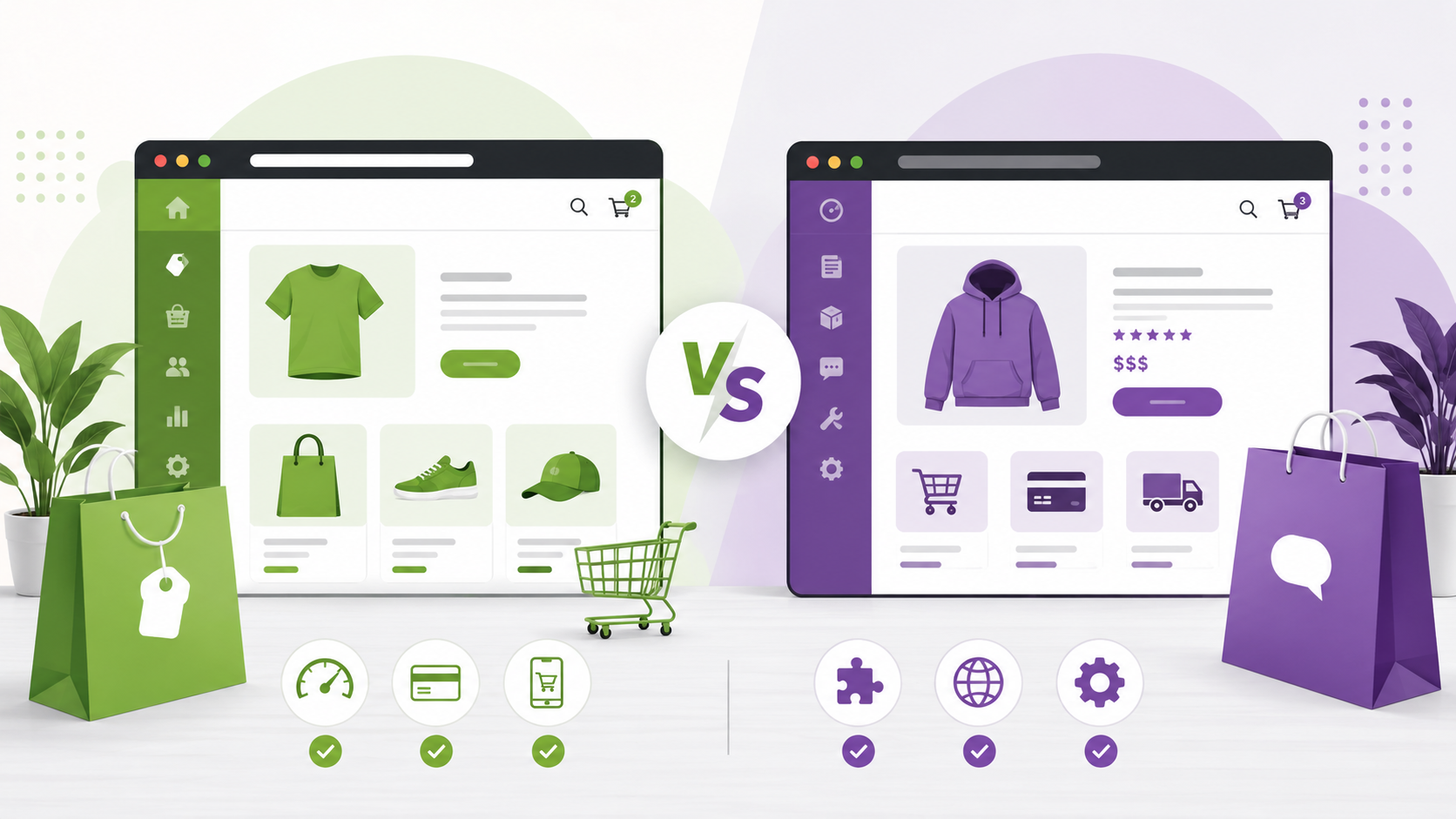
Choosing the right e-commerce platform is one of the most consequential decisions you'll make as an online retailer. Get it right and you have a foundation that scales with your business. Get it wrong and you face costly migrations, lost sales, and technical headaches. Shopify and WooCommerce are the two dominant players, and they represent fundamentally different philosophies. This guide breaks down everything you need to know to make the right choice.
Shopify: The All-in-One Hosted Solution
Shopify is a software-as-a-service (SaaS) platform — you pay a monthly subscription and get hosting, security, and updates included. Setup is fast, the interface is intuitive, and virtually everything works out of the box. Shopify hosts over 1.7 million merchants and processes hundreds of billions in gross merchandise volume annually, which gives it the scale to maintain robust uptime and continuous feature development.
WooCommerce: The Open-Source WordPress Plugin
WooCommerce is a free, open-source plugin that turns a WordPress site into a full-featured e-commerce store. You own your platform entirely — the code, the data, the flexibility. The trade-off is that you manage hosting, security, updates, and plugins independently. For developers and technically capable business owners, this control is liberating. For beginners, it can be overwhelming.
Ease of Use Comparison
Shopify wins the ease-of-use comparison decisively. The guided setup wizard, built-in payment processing, and curated app store mean most merchants can have a functional store live within hours. WooCommerce requires WordPress familiarity, plugin management, hosting configuration, and more technical troubleshooting. Neither is impossible to learn, but the learning curves are meaningfully different.
Cost Comparison
Shopify's basic plan starts around $39/month with a transaction fee for external payment processors. WooCommerce itself is free, but hosting, a premium theme, extensions, and security tools typically add up to $50–$150/month for a comparable setup. At scale, Shopify's higher plan costs and transaction fees can exceed WooCommerce's hosting and extension costs — making WooCommerce potentially cheaper for high-volume sellers.
Customization and Flexibility
WooCommerce is nearly limitless in customization capability — with direct access to code, thousands of themes, and a vast ecosystem of plugins. Shopify is more constrained but has improved significantly with its Liquid templating language and extensive app store. For unique business models, complex B2B features, or deep integrations with custom systems, WooCommerce typically offers more flexibility.
Payment Processing
Shopify Payments (powered by Stripe) is built in and waives transaction fees. Accepting third-party payment processors incurs fees of 0.5–2% per transaction depending on your plan. WooCommerce integrates with virtually any payment gateway at no extra platform fee — giving merchants more freedom and potentially lower transaction costs for high-volume stores.
Scalability and Performance
Shopify's infrastructure scales automatically — you don't worry about server capacity during traffic spikes. WooCommerce performance depends entirely on your hosting configuration. With the right managed WooCommerce host (Kinsta, WP Engine, Nexcess), performance can match or exceed Shopify. But it requires more active management and potentially higher hosting costs at scale.
Who Should Choose Shopify
Shopify is ideal for entrepreneurs who want to focus on selling rather than managing technology, for brick-and-mortar stores adding an online channel, for dropshippers, and for businesses that want predictable monthly costs with minimal technical overhead. If you value simplicity and speed to market over maximum customization, Shopify is your platform.
Who Should Choose WooCommerce
WooCommerce is ideal for WordPress users who want to extend existing sites, for developers building for clients, for businesses with complex product configurations, and for merchants who want to avoid platform lock-in. If technical control, ownership of your data, and long-term cost management matter more than ease of setup, WooCommerce is the right choice.